> ## Documentation Index
> Fetch the complete documentation index at: https://statsig-4b2ff144-serverless-cloudflare.mintlify.site/llms.txt
> Use this file to discover all available pages before exploring further.
# Bayesian Experiments
> Learn about Bayesian A/B testing on Statsig, including informative priors and implementation details.
### Bayesian Testing in Statsig
Experiments are frequentist by default. To switch to Bayesian mode, go to Advanced Settings.
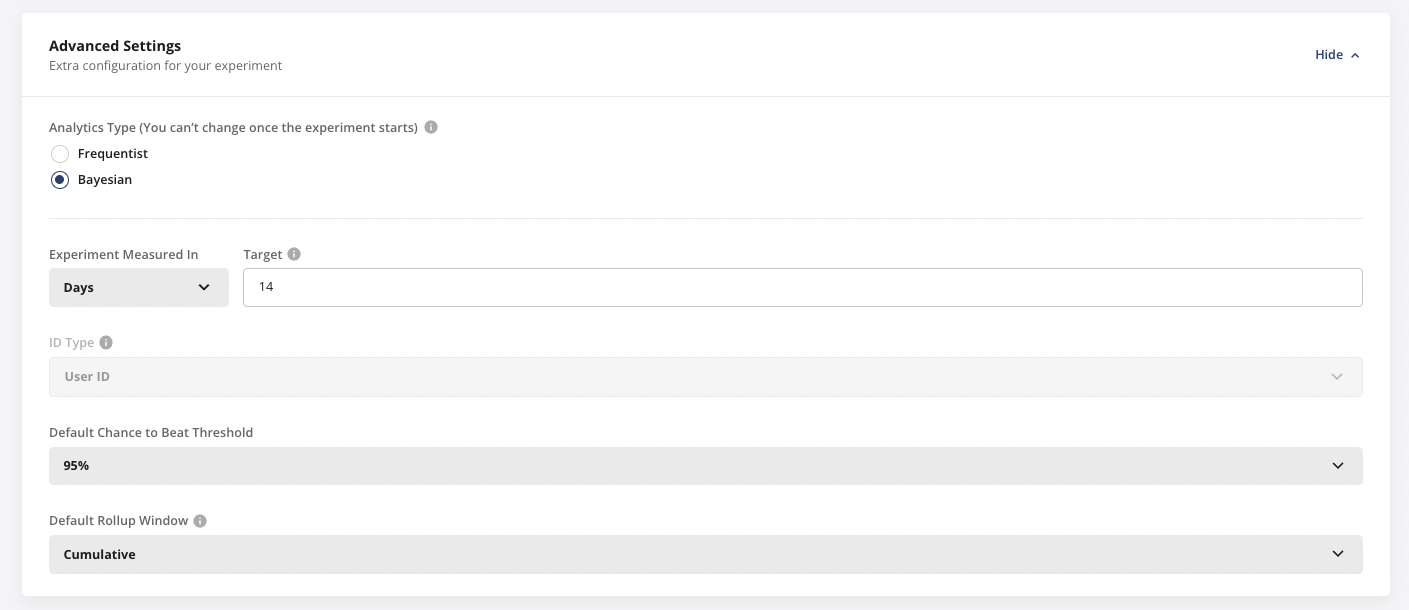 The experiment type cannot be modified once the experiment starts.
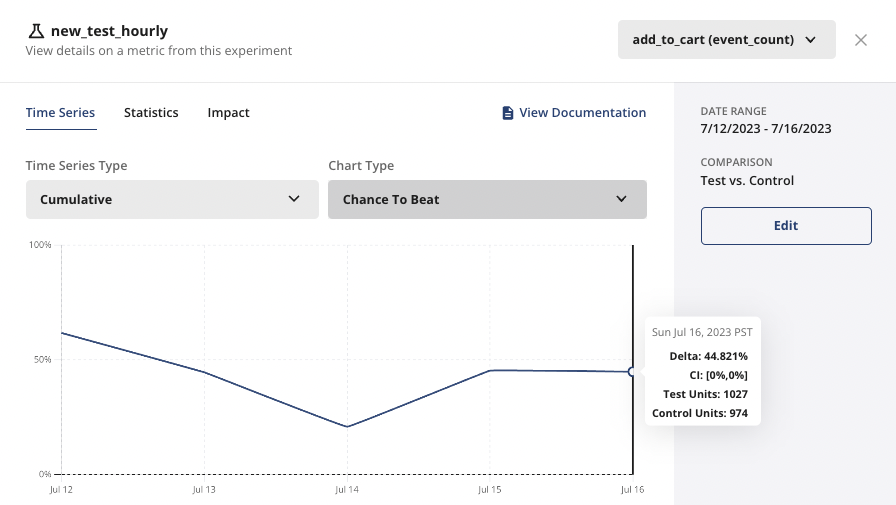
 Deep dive analysis should also reflect Bayesian statistics
 ### Informed Bayesian
Bayesian experiments allow you to specify a prior belief on the relative average treatment effect. Statsig will combine the prior distribution with the observed data to display the prior-adjusted results. You can enable this by selecting the option to "use informative priors".
### Informed Bayesian
Bayesian experiments allow you to specify a prior belief on the relative average treatment effect. Statsig will combine the prior distribution with the observed data to display the prior-adjusted results. You can enable this by selecting the option to "use informative priors".
 ### Drawing the Correct Prior Distribution From Historical Data
If you are using the Bayesian with informative priors, the assumption is that you have a clear understanding of what power the priors have over your experimental results, and your organization has established a reliable prior based on the domain knowledge. With that said, here are some patterns people follow to derive their priors:
1. You can use the $AVG(\text{average treatment effect})$ of past experiments with a similar setup and population as your prior mean. You can use the standard deviation, or a multiple of it, as the prior standard error.
2. You can also use the $AVG(\text{observed standard error})$ as your prior standard error.
### Implementation Details
Denote $\mathcal{N}(ATE_{prior}, STE_{prior}^2)$ as the prior distribution, where $ATE_{prior}$ is the average treatment effect and $STE_{prior}$ is the standard error. Similarly, $\mathcal{N}(ATE_{observed}, STE_{observed}^2)$ as the observed distribution.
The posterior distribution is then calculated as
$$
ATE_{post} =
\frac{
\frac{ATE_{prior}}{STE_{prior}^2} +
\frac{ATE_{observed}}{STE_{observed}^2}
}{
\frac{1}{STE_{prior}^2} +
\frac{1}{STE_{observed}^2}
}
$$
$$
STE_{post}^2 =
\frac{1}{
\frac{1}{STE_{prior}^2} +
\frac{1}{STE_{observed}^2}
}
$$
If the prior is not specified, the $\mathcal{N}(ATE_{prior}, STE_{prior}^2)$ is represented as $\mathcal{N}(0, \infty)$.
### Bayesian Statistics
Bayesian A/B tests have a glossary that are different from the frequentist framework and often believed to be more intuitive in communication to non-technical audience.
* Credible Interval: the interval which we believe contains the true parameter at the given probability
* Chance to Beat: the probability that the test is better than control
* Expected Loss: the average potential risk if you ship test
### Drawing the Correct Prior Distribution From Historical Data
If you are using the Bayesian with informative priors, the assumption is that you have a clear understanding of what power the priors have over your experimental results, and your organization has established a reliable prior based on the domain knowledge. With that said, here are some patterns people follow to derive their priors:
1. You can use the $AVG(\text{average treatment effect})$ of past experiments with a similar setup and population as your prior mean. You can use the standard deviation, or a multiple of it, as the prior standard error.
2. You can also use the $AVG(\text{observed standard error})$ as your prior standard error.
### Implementation Details
Denote $\mathcal{N}(ATE_{prior}, STE_{prior}^2)$ as the prior distribution, where $ATE_{prior}$ is the average treatment effect and $STE_{prior}$ is the standard error. Similarly, $\mathcal{N}(ATE_{observed}, STE_{observed}^2)$ as the observed distribution.
The posterior distribution is then calculated as
$$
ATE_{post} =
\frac{
\frac{ATE_{prior}}{STE_{prior}^2} +
\frac{ATE_{observed}}{STE_{observed}^2}
}{
\frac{1}{STE_{prior}^2} +
\frac{1}{STE_{observed}^2}
}
$$
$$
STE_{post}^2 =
\frac{1}{
\frac{1}{STE_{prior}^2} +
\frac{1}{STE_{observed}^2}
}
$$
If the prior is not specified, the $\mathcal{N}(ATE_{prior}, STE_{prior}^2)$ is represented as $\mathcal{N}(0, \infty)$.
### Bayesian Statistics
Bayesian A/B tests have a glossary that are different from the frequentist framework and often believed to be more intuitive in communication to non-technical audience.
* Credible Interval: the interval which we believe contains the true parameter at the given probability
* Chance to Beat: the probability that the test is better than control
* Expected Loss: the average potential risk if you ship test