> ## Documentation Index
> Fetch the complete documentation index at: https://statsig-4b2ff144-serverless-cloudflare.mintlify.site/llms.txt
> Use this file to discover all available pages before exploring further.
# When to Use Feature Gates vs. Experiments?
> Decide whether to ship with a feature gate or run an experiment, and understand how the two work together.
In Statsig, feature flags are called feature gates. The terminology is interchangeable throughout this guide.
Both feature gates and experiments create control/test groups. Use this guide to pick the right tool for your launch and measurement goals.
***
## Quick Guidance
* **Choose a feature gate** when you want to roll out a feature gradually or monitor impact as you ramp.
* **Choose an experiment** when you need to compare multiple variants and quantify the lift across metrics.
***
## Key Differences
### Variants
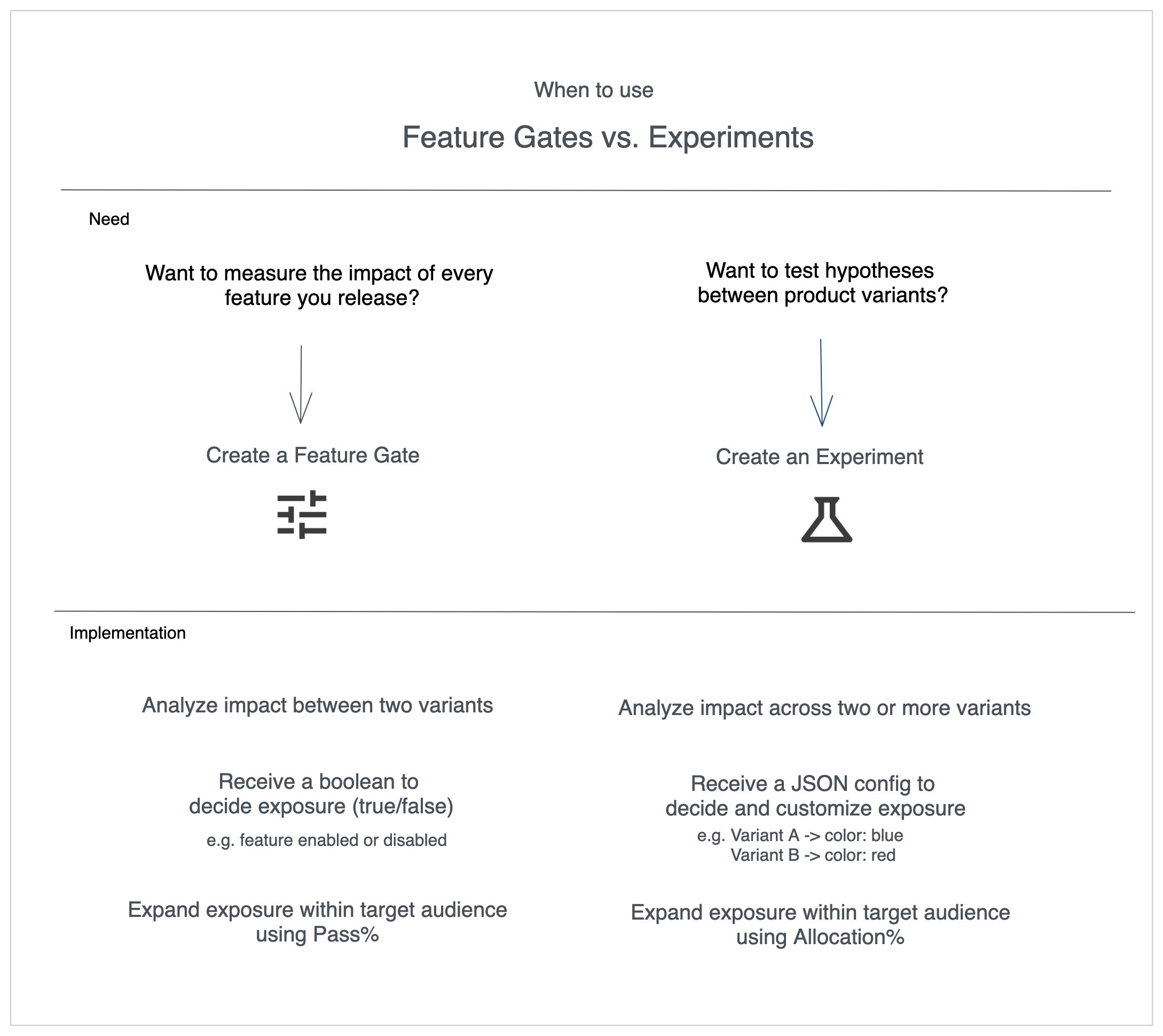
* **Feature gate** → Two experiences only: pass vs. fail.
* **Experiment** → Any number of variants.
When viewing gate exposures you’ll see three buckets: Pass, Fail, and Fail – Not in Analysis. Only the balanced subset of the fail group is used for metric comparisons. Learn more in the [gate exposure methodology](/feature-flags/view-exposures#gate-exposures).
### Return Values
* **Feature gate** → Boolean (`true`/`false`) so your application toggles code paths.
* **Experiment** → JSON config that describes the variant (colors, copy, thresholds, etc.).
### Ramping knobs
* **Feature gate** → Adjust Pass % to send more traffic to the new experience. You can go beyond 50/50 (e.g. 99% vs 1%).
* **Experiment** → Adjust Allocation % to enroll more users, but splits cap at 50/50.
Once a user is assigned, neither control reshuffles existing users—you can safely ramp without re-bucketing.
 ***
## When Experiments Shine
Use experiments when you need:
1. **Multiple variants or personalization** – compare more than two options or tailor experiences via contextual bandits/layers.
2. **Stable identifiers and custom IDs** – analyze behavior before signup with stable IDs, or use custom IDs for sessions, workspaces, or geography.
3. **Isolated universes** – run parallel experiments safely by placing them in their own layers.
***
## When Feature Gates Shine
Feature gates are great for:
* **Safe rollouts** – gradually increase exposure while observing metrics.
* **Targeting audiences** – use gates as pre-filters before enrolling users in an experiment.
In experiment setups, gates often act as targeting criteria. The flow looks like this:
1. **Targeting gate** picks the eligible audience.
2. **Allocation %** (experiment) decides how much of that audience participates.
3. **Split %** distributes participants across variants.
Once you choose a winner, you can lift the targeting gate and let the winning variant reach everyone.
***
## Putting It Together
* Start with a **feature gate** if you have a single variant to launch carefully.
* Reach for **experiments** when you need quantitative comparisons across variants.
* Combine both when you want precise audience control plus rigorous measurement.
Need more depth? Check out:
* [Feature gate exposures](/feature-flags/view-exposures)
* [Experiments overview](/experiments-plus)
* [Layers for mutual exclusion](/layers)
***
## When Experiments Shine
Use experiments when you need:
1. **Multiple variants or personalization** – compare more than two options or tailor experiences via contextual bandits/layers.
2. **Stable identifiers and custom IDs** – analyze behavior before signup with stable IDs, or use custom IDs for sessions, workspaces, or geography.
3. **Isolated universes** – run parallel experiments safely by placing them in their own layers.
***
## When Feature Gates Shine
Feature gates are great for:
* **Safe rollouts** – gradually increase exposure while observing metrics.
* **Targeting audiences** – use gates as pre-filters before enrolling users in an experiment.
In experiment setups, gates often act as targeting criteria. The flow looks like this:
1. **Targeting gate** picks the eligible audience.
2. **Allocation %** (experiment) decides how much of that audience participates.
3. **Split %** distributes participants across variants.
Once you choose a winner, you can lift the targeting gate and let the winning variant reach everyone.
***
## Putting It Together
* Start with a **feature gate** if you have a single variant to launch carefully.
* Reach for **experiments** when you need quantitative comparisons across variants.
* Combine both when you want precise audience control plus rigorous measurement.
Need more depth? Check out:
* [Feature gate exposures](/feature-flags/view-exposures)
* [Experiments overview](/experiments-plus)
* [Layers for mutual exclusion](/layers)